2011. Most people had never heard of Bitcoin. The ones who had were scattered across obscure tech blogs, Bitcointalk forum threads, and encrypted IRC channels. They were talking about a digital currency with no bank, no government, and no address. Just math, ideology, and a whitepaper that most of the world had never read. And then, one afternoon in a corner of the internet most people still did not know existed, a hidden marketplace appeared. It accepted only one form of payment: Bitcoin.
What followed was one of the most controversial and fascinating chapters in the early history of the bitcoin nostalgia era. A chapter that shook the forums, tested the ideology, and forced every believer to ask a question nobody wanted to answer: Is this what we built it for?
I was watching from the sidelines the whole time. No wallet. No holdings. Just a screen, a forum, and a growing sense that I was witnessing something history would spend decades trying to explain.
The Underground Marketplace That Put Bitcoin on a Different Map
Before Silk Road, Bitcoin was a nerd's experiment. The price was almost laughably small.
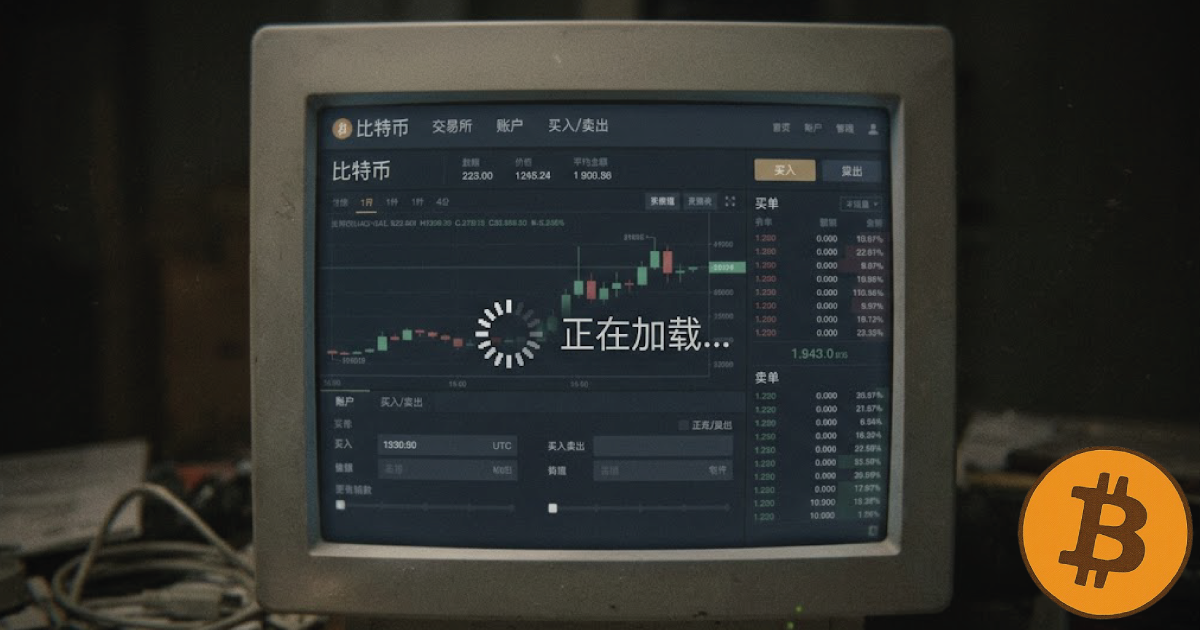
I remember a screenshot circulating across early forums, one of those grainy, Wayback Machine-worthy captures that passed from thread to thread like a digital artifact. It showed a price that most people today would not believe.
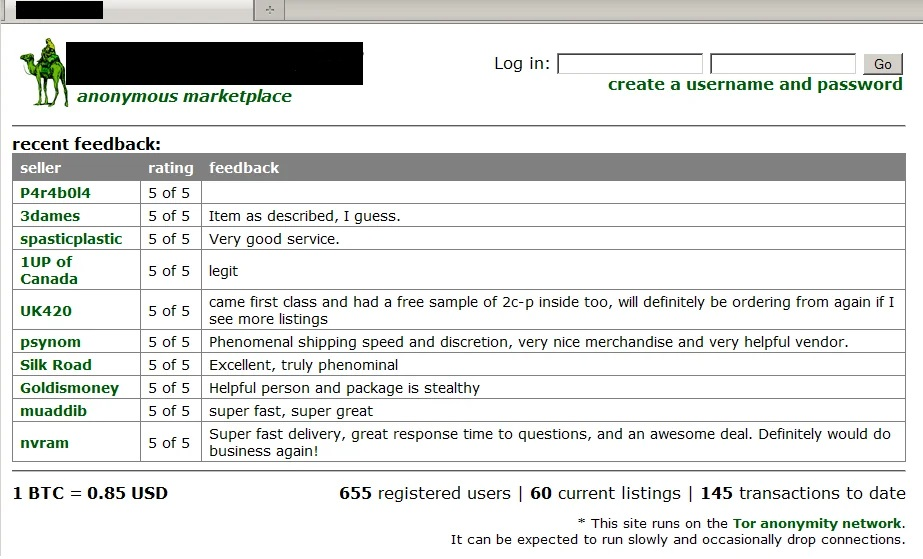
One Bitcoin for eighty-five cents. People were mining on home computers, tipping each other small amounts on forum posts, and debating whether Satoshi's creation would survive the year. Nobody was watching charts. Nobody was waiting for an all-time high.
Then came Silk Road.
Launched in February 2011 by an anonymous operator, the site ran exclusively on Tor, the anonymizing network that routes internet traffic through layers of encrypted relays. The only accepted currency was Bitcoin. Not dollars. Not PayPal. Not gold. Bitcoin.
It was the first time most people outside the cypherpunk world had a concrete, tangible reason to want Bitcoin. Not for the whitepaper. Not for ideology. For access. And that changed everything.
The Bitcointalk forums exploded overnight.
Bitcointalk Reacts: The Thread That Divided a Community
Nostalgic MomentThe Bitcointalk forum in 2011 was the closest thing Bitcoin had to a town square. Every debate, every discovery, and every disaster passed through those threads first.
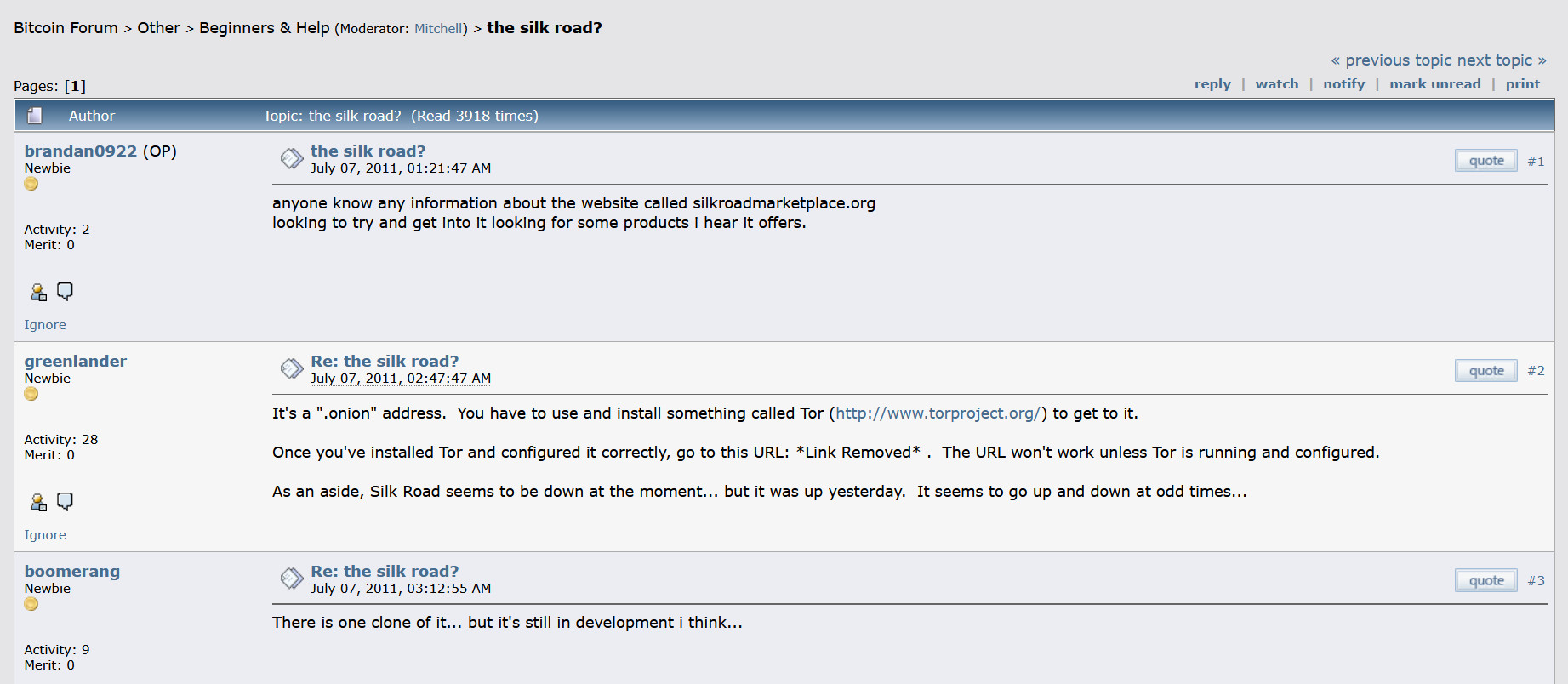
In June 2011, a thread exploded after Adrian Chen published a piece in Gawker titled "The Underground Website Where You Can Buy Any Drug Imaginable." The article linked directly to Silk Road and named Bitcoin as its engine.
The Bitcointalk reaction was immediate and brutally divided.
Some users were alarmed. They had spent years quietly building Bitcoin's credibility, explaining to skeptical friends and family that this was a serious technology with serious implications. Now a high-traffic tabloid website was calling it the financial backbone of an anonymous drug marketplace.
Others argued something harder to dismiss: Silk Road was Bitcoin working exactly as Satoshi had designed. Censorship-resistant. Permissionless. Without an intermediary to call and ask questions.
The argument broke open a fault line that would run through the Bitcoin community for years afterward. It was never just about Silk Road. It was about what Bitcoin was for, and who got to decide.
The Name That Haunted the Forums: Who Was Dread Pirate Roberts?
The operator of Silk Road never used a real name.
He called himself Dread Pirate Roberts. And if you spent any part of the 1980s or 90s near a television or a VHS player, that name should ring a very specific bell.
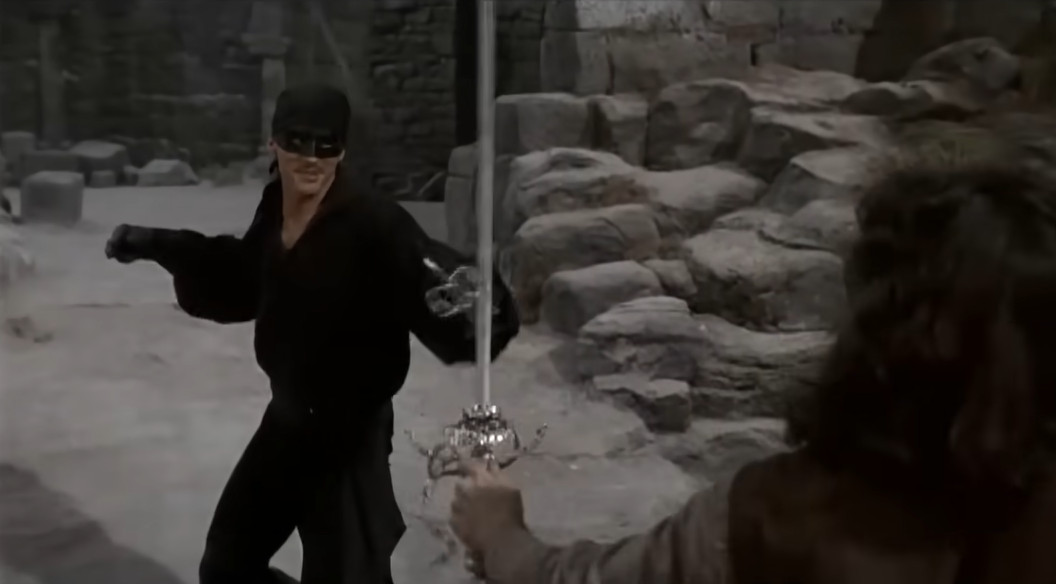
In the 1987 film The Princess Bride, adapted from William Goldman's 1973 novel, the Dread Pirate Roberts is not a single person. He is a title. A legacy. The original pirate retires and hands the name, the ship, and the feared reputation to the next captain. No one ever knows who is truly behind the mask. The legend continues without the person.
The symbolism was not accidental. Whoever chose that name was sending a message to anyone paying attention: I am not a person. I am an idea. You can capture the body, but you cannot capture the concept.
It was a deeply literary choice for what many assumed was simply a marketplace for contraband. And it said something about the person behind the keyboard: they were ideological, well-read, and entirely conscious of the mythology they were constructing around themselves.
On the forums, people debated the name endlessly. Some found it theatrical. Some found it chilling. A few thought it was brilliant. All of them kept talking about it, which was probably the point.
A Princess Bride, a Pseudonym, and a Philosophy
Reading the early writings attributed to Dread Pirate Roberts, you get an unsettling sense of someone who genuinely believed they were constructing something philosophically important.
The public communications posted on Silk Road spoke of personal freedom, voluntary exchange, and the removal of state coercion from economic transactions. The language echoed libertarian economists and cypherpunk manifestos with almost academic precision.
Whether you agreed with that worldview or found it a dangerous justification for real harm, the rhetoric was coherent. This was not someone who stumbled onto the dark web by accident. This was someone who had been thinking about these ideas for a long time, long before Silk Road launched.
For those of us watching from the sidelines on Bitcointalk and early Reddit threads, it was impossible not to notice how directly the Silk Road philosophy connected to the founding ideas of Bitcoin itself: the right to transact without permission, without intermediaries, without surveillance.
The discomfort was real. The ideological overlap was real. And nobody on the forums could entirely look away.
The World Outside Was Watching, and It Was Not Happy
Senator Chuck Schumer held a press conference in June 2011.
He stood at a podium and called for the immediate shutdown of Silk Road. He named Bitcoin specifically, calling it an online form of money laundering that needed to be eliminated. It was one of the first times a sitting United States senator had addressed Bitcoin by name on the record.
"Shut it down," Schumer said. "Close this website." Along with Senator Joe Manchin, he sent a letter to the DEA and the Justice Department demanding federal action against Silk Road and, by name, the Bitcoin network that powered it.
June 2011, U.S. Senate press conference. One of the earliest official government responses to the existence of Bitcoin.
For many early adopters watching from their laptops, that press conference felt like the moment the outside world finally noticed Bitcoin. And not in the way anyone had been hoping for.
The price of Bitcoin, which had briefly touched thirty dollars in mid-2011 before a sharp correction, was once again in the crosshairs. The correlation between Silk Road's public exposure and Bitcoin's price volatility became a recurring story for mainstream journalists who otherwise had no idea what a blockchain was.
But the cultural damage was different from the financial damage.
Bitcoin had been fighting a quiet battle for legitimacy as a technology. Silk Road handed its critics the most powerful argument they had ever had. For a long time, the first thing many Americans heard about Bitcoin was not the whitepaper, not the cypherpunk vision, not the elegant engineering of a trustless ledger.
It was the dark web drug market.
That framing took years to dislodge. Some argue it never fully disappeared.
October 2, 2013: The Day the Legend Ended
On a quiet Tuesday afternoon in a public library in San Francisco, a 29-year-old named Ross William Ulbricht was arrested by FBI agents.
The agents moved fast, catching him mid-session on his open laptop to preserve the encrypted data before he could close it. It was a deliberate and carefully coordinated operation. Within minutes, the evidence was in federal custody.
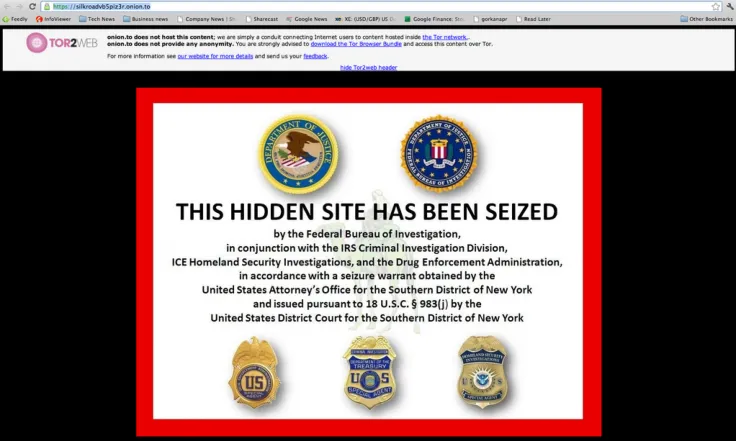
Silk Road was seized. The domain went dark. In its place appeared the now-iconic FBI seizure notice: a stark government seal placed over the URL where a bustling underground marketplace had operated for more than two years.
Ulbricht was charged with drug trafficking, continuing criminal enterprise, computer hacking, and conspiracy to commit murder for hire. He was convicted in 2015 and sentenced to two life terms plus forty years without the possibility of parole by Judge Katherine Forrest of the Southern District of New York.
Archive Update — January 21, 2025
On January 21, 2025, President Donald Trump granted Ross Ulbricht a full and unconditional pardon, fulfilling a promise he had made to Libertarian supporters at the 2024 Libertarian National Convention. Ulbricht was released from the United States Penitentiary in Tucson, Arizona, that same evening, after serving approximately twelve years. The "Free Ross" movement, which had gathered over 600,000 petition signatures and sustained years of advocacy, had reached its goal. Whatever one's view of Silk Road and its consequences, the pardon closed one of the most debated chapters in Bitcoin's early legal history.
The fall of Silk Road rippled through the Bitcoin community in ways that took years to fully process. Part of the reaction was relief. Part of it was grief. Part of it was a slow and uncomfortable reckoning with the fact that this technology, which had started as an idealistic experiment between cryptographers, now had a very public and very complicated history to carry forward.
For those of us who had followed the story from those early Bitcointalk threads since 2011, the arrest felt like the closing of a chapter that nobody had written cleanly. The pardon, more than a decade later, felt like a postscript no one had expected.
Further Reading
A Timeline of Bitcoin Nostalgia: The Iconic Events and Milestones That Shaped Crypto History →For the broader arc of the milestones that surrounded Silk Road — from the genesis block to the institutional era — the full picture lives in this archive.
What the Silk Road Chapter Meant for Bitcoin's Story
Silk Road did not destroy Bitcoin.
But it shaped the movement in ways that are still being untangled today.
It forced a conversation about dual-use technology that the community had been quietly avoiding. It demonstrated, in the most dramatic terms possible, that a permissionless monetary network truly was permissionless, for better and for worse. It handed governments their first real justification for regulatory scrutiny of Bitcoin and the broader digital currency ecosystem.
And it did something else that nobody could ignore.
It proved that Bitcoin worked.
Not in a way anyone could celebrate without significant qualification. But the underlying technology processed millions of dollars in anonymous transactions on a dark web marketplace for over two years without a single technical failure. Whatever you thought about Silk Road morally, the blockchain did exactly what it was designed to do. Every satoshi moved. Every ledger entry confirmed. Every transaction verified.
For those who had read the whitepaper in 2008 or 2009 and believed in the engineering, that fact was genuinely hard to dismiss.
The impact of Silk Road on early Bitcoin sentiment runs parallel to what came next: the collapse of the Mt. Gox exchange in 2014, another massive shock to a young community still trying to define itself in public. Two disasters, two different causes, and one shared consequence: Bitcoin had to keep proving itself to a world that had already made up its mind.
Related Archive
The Impact of Mt. Gox on Early Bitcoin User Sentiment and Nostalgia →The full story of how that trust was broken and rebuilt is documented in this archive. The two stories belong together — Silk Road and Mt. Gox are the twin pillars of Bitcoin's most turbulent early chapter.
A Gift for Everyone Who Was There
This one is for the forum readers, the lurkers, the ones who remember the ASCII art and the heated threads. The ones who watched a legend get built and dismantled in real time, from the other side of a screen.
Bitcoin Nostalgia — For Those Who Were There
Dread Pirate Roberts — A Musical Tribute
Play it. Remember. This is what bitcoin nostalgia sounds like.
Frequently Asked Questions
What was Silk Road?
Silk Road was a dark web marketplace that operated from February 2011 to October 2013. It ran exclusively on the Tor network and accepted only Bitcoin as payment. It was the first major platform to bring Bitcoin into widespread underground use and gave many outsiders their first awareness of the currency.
Who was Dread Pirate Roberts?
Dread Pirate Roberts was the pseudonym used by the operator of Silk Road. The name is taken from the 1987 film The Princess Bride, where the Dread Pirate Roberts is a legacy title passed between individuals, not a single identity. The real person behind the name was identified by federal investigators as Ross William Ulbricht, who was arrested in San Francisco in October 2013 and convicted in 2015. He was sentenced to two life terms plus forty years. On January 21, 2025, President Donald Trump granted Ulbricht a full and unconditional pardon, and he was released from federal prison after serving approximately twelve years.
How did Silk Road affect Bitcoin's early reputation?
Silk Road gave Bitcoin its first major mainstream media exposure, but almost entirely in a negative context. It triggered a 2011 Senate press conference calling for Bitcoin to be shut down and became the primary argument for critics who associated Bitcoin with criminal activity for years afterward. The association proved difficult to shake, even as Bitcoin's use cases expanded well beyond Silk Road's era.
Was Ross Ulbricht the only person behind Silk Road?
The operation involved multiple administrators and staff over its two-year run. While Ulbricht was identified as the site's founder and primary operator, several other individuals connected to Silk Road were also investigated and prosecuted in subsequent federal cases. Notably, two federal agents involved in the investigation, Carl Force IV and Shaun Bridges, were later convicted of stealing Bitcoin from Silk Road during their undercover work.
Was Ross Ulbricht pardoned?
Yes. On January 21, 2025, President Donald Trump granted Ross Ulbricht a full and unconditional pardon, fulfilling a public campaign promise he had made to Libertarian supporters at the 2024 Libertarian National Convention. Ulbricht was released from the United States Penitentiary in Tucson, Arizona, that same evening, after serving approximately twelve years. The pardon was celebrated by the Bitcoin and libertarian communities but drew criticism from some lawmakers and prosecutors who had worked on the original case.
Help Keep This Memory Archive Alive
If you were reading those threads in 2011, watching the Senate hearing from a dorm room, or lurking on Bitcointalk while the forums erupted after the Gawker article, you already know how fast these memories fade.
The forum posts disappear. The screenshots go offline. The people who were there get older and quieter and move on to other lives. Without an archive, this history dissolves into noise.
This site exists to make sure those stories survive. Every article, every visual, every archived thread is a piece of the record.
If you believe this history is worth preserving, consider helping keep this memory alive with a small Bitcoin donation. Every satoshi goes directly into maintaining and expanding the archive.
Support Bitcoin Nostalgia
Bitcoin Nostalgia runs on memory and community support. If this archive has ever brought back a moment, a name, or a feeling from those early days, help us keep it alive. Every sat keeps the archive running. Thank you for remembering with us.
bc1qu6v3m430v9ca0kxm3qk8cewcwukmfpf5rqakrj
There was a version of the internet in 2011 where anything felt possible and nothing felt entirely safe. Where someone could build an entire underground economy on a whitepaper and a dream, and disappear behind a reference to a movie about a pirate who was never just one person.
We were all just watching. Some of us never stopped.
Keep the memory alive. — Angel, Founder & Chief Archivist, Bitcoin Nostalgia
Disclaimer: This article is a historical and cultural archive. Nothing in this publication constitutes financial advice, investment guidance, or price speculation. Bitcoin Nostalgia is a memory archive, not a financial publication. All historical references are based on publicly available records, archived forum posts, and documented community history. Sources include archived Bitcointalk threads, the Silk Road Wikipedia record, court documents and contemporaneous reporting by CNN, CNBC, and NPR, and the Wayback Machine.