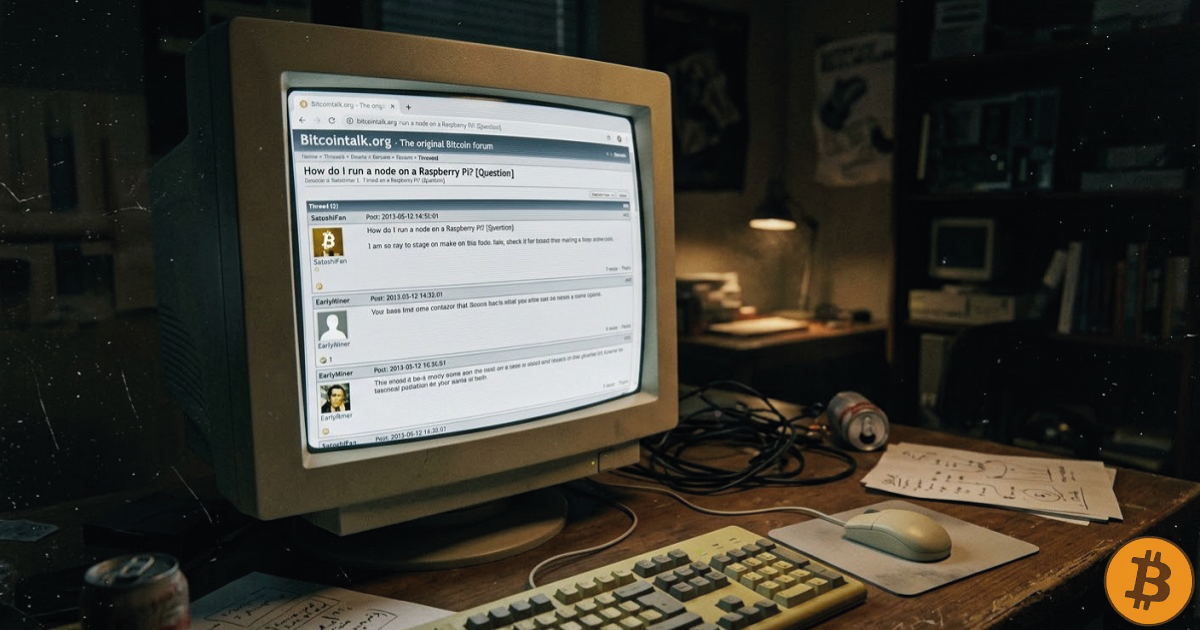
There was a time, not so long ago, when Bitcoin lived entirely in the dark corners of the internet. No headlines. No ticker symbols. No celebrity endorsements. Just a scattered tribe of coders, libertarians, and curious strangers hunched over keyboards at all hours, arguing passionately on forums that most people have never heard of. This is not a story about price. It is a story about culture — about the forum posts and inside jokes and stubborn believers who gave Bitcoin nostalgia its deepest meaning before the world decided to pay attention.
The tragedy is simple: those stories are disappearing. Every year, another piece of the original Bitcoin community fades into the noise of the modern era. And if nobody preserves them, they will be gone forever. This is the archive. This is that story.
Before the Memes, There Was the Message

It started, officially, on October 31, 2008. A nine-page white paper appeared on a cryptography mailing list. The author was someone calling themselves Satoshi Nakamoto. The subject line read simply: Bitcoin P2P e-cash paper.
Most of the list's subscribers ignored it. A few replied with skepticism. One or two expressed genuine curiosity. But buried inside the response threads was something important: a philosophical argument. Satoshi was not just proposing a new payment system. He was making a cultural statement about trust, banks, and the nature of money itself.
"The root problem with conventional currency is all the trust that's required to make it work."
Satoshi Nakamoto, Bitcointalk, February 2009
Early adopters were not in it for wealth. They were in it for the idea. They were coders, anarchists, economists who distrusted central authority, and nerds who simply found the technology elegant. The original Bitcoin community was assembled from mailing lists, early Reddit threads, and the quiet corners of forums that felt more like underground clubs than marketplaces.
To understand bitcoin nostalgia as a living, breathing thing, you have to understand that the culture came first. The prices, the institutions, the mainstream attention all came much later.
The Forums That Built a Culture
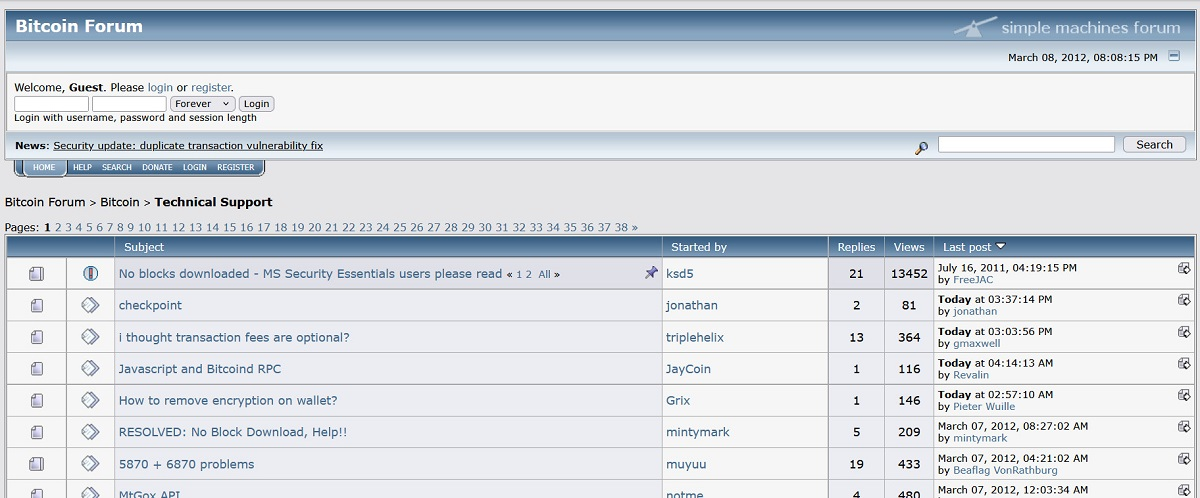
On July 22, 2010, Satoshi Nakamoto launched Bitcointalk.org. It is impossible to overstate what this forum meant to the early Bitcoin community. Bitcointalk was not just a place to discuss software. It was a town square, a debate hall, a confessional booth, and sometimes a chaotic food fight. All at once.
The early threads read like dispatches from a different planet. People discussed whether Bitcoin would ever be worth anything. They theorized about the identity of Satoshi. The forum attracted a very specific kind of person in those early years: deeply technical but also deeply ideological. Many came from the cypherpunk movement, a loosely organized group of activists and cryptographers who had been arguing since the 1990s that strong cryptography was a fundamental tool for individual liberty.
Eric Hughes's "A Cypherpunk's Manifesto" from 1993 had laid the groundwork. Bitcoin was, to many early adopters, the practical realization of that vision. And Bitcointalk was where they came to celebrate, debate, and occasionally tear each other apart.
Further Reading
The Genesis Era: A Comprehensive Guide to Bitcoin's Early Days and Technological Origins →For the full story of Bitcoin's technological and cultural foundations, from the genesis block to the first global wave of recognition.
I found Bitcointalk early, long after the original community had already established its rituals and language. Even as a lurker, even as someone who could not afford to participate, I felt the electricity of it. There was a genuine sense that something historic was happening in real time.
Reddit's r/Bitcoin community formed around the same era. Early moderators tried to keep it focused, but it quickly became an overflow valve for every argument, discovery, and inside joke that the forums generated. These two communities, Bitcointalk and early Reddit, were the original Bitcoin culture. Everything that came after — the memes, the slang, the mythology — came out of these spaces.
HODL: The Typo That Became a Legend
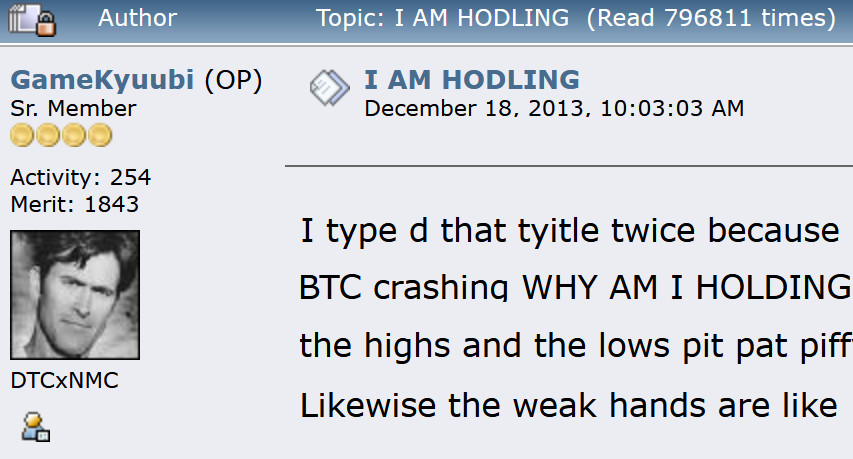
On December 18, 2013, Bitcoin's price had just crashed sharply from a historic peak near $1,200. Panic was spreading across the forums. New users who had arrived during the bull run were selling. The media was writing Bitcoin's obituary for what felt like the hundredth time.
Then, at 10:03 AM, a Bitcointalk user named GameKyuubi posted a thread titled: I AM HODLING. The post was unfiltered. He was, by his own admission, slightly drunk and deeply frustrated. He had watched Bitcoin fall and made a decision: he was not selling. He misspelled "holding" as "hodling" and did not bother to correct it. The rest of the post became a passionate, somewhat rambling defense of why he was staying put.
The community noticed immediately. Not just the message, but the typo. Within hours, HODL had become a rallying cry. By the next day it was spreading across Reddit and Bitcointalk. Within a week, it had escaped the forums entirely.
Nostalgic Moment
GameKyuubi was not writing investment strategy. He was writing a kind of rough, imperfect poetry about conviction. He was capturing something real about the way early Bitcoin adopters thought about what they were holding. It was not just a coin to them. It was a belief.
HODL became a cultural shorthand for long-term commitment to the idea behind Bitcoin, not just to its price. It was born from panic, typed with imperfect fingers by someone who was frustrated and a little irrational, and it survived because it captured a genuine emotional truth about the early Bitcoin community. That is exactly what bitcoin nostalgia is made of.
A typo born in a moment of panic became the defining cultural artifact of Bitcoin's early era — because it was honest.
Act I — The Scene
December 18, 2013 — 10:03 AM
Bitcoin has just lost 39% in 72 hours. The forums are in chaos.
New buyers who arrived during the November peak are panic-selling. The media is publishing Bitcoin obituaries. Longtime forum members are watching their portfolios collapse in real time.
Then, a user named GameKyuubi posts a thread. He is, by his own admission, slightly drunk and deeply frustrated. He types fast and does not proofread.
"I AM HODLING"
WHY AM I HOLDING? I'LL TELL YOU WHY. It's because I'm a bad trader and I KNOW I'M A BAD TRADER. Yeah you good traders can spot the highs and lows... but I'm not good at that so... I AM HODLING and no other reason.
The markets are open. Your position is on the line. The question is simple.
Act II — The Wait
Checking the archives…
December 18, 2013 → what happened next…
Act III — The Verdict
● You HODLedYou are GameKyuubi. You held.
On December 18, 2013, Bitcoin was at $576. The forums were in freefall. You stayed.
By early 2017, that same Bitcoin had crossed $1,000 again. By December 2017, it reached $19,000. You would not have needed to time the market. You just needed to not sell that morning.
GameKyuubi — Bitcointalk, December 18, 2013
This is what bitcoin nostalgia is made of. Not the chart. The conviction of a slightly drunk man on a Tuesday morning who refused to sell.
Act III — The Verdict
● You FoldedLike most people that day. You are not alone.
On December 18, 2013, Bitcoin was at $576. Selling felt like the rational thing to do. Most people did exactly what you did.
Nobody could know that GameKyuubi's typo would become a cultural artifact. Nobody could know the price would reach $19,000 four years later. Hindsight is easy. The fog of that morning was real.
Angel Salvador Dominguez — Bitcoin Nostalgia
The point of this archive is not to make you regret. It is to make sure you understand what that moment felt like — so the human story behind the chart is never lost.
The Memes That Shaped a Movement
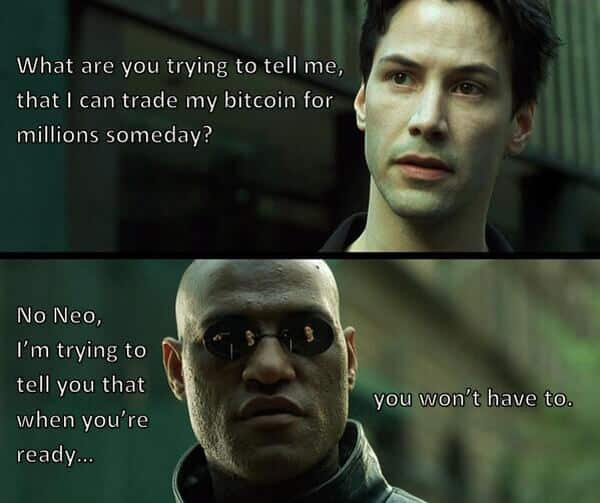
Before Bitcoin had advertising budgets or corporate communications teams, it had memes. And the early crypto memes were unlike anything the internet produces today. They were crude. They were often poorly lit images edited in Microsoft Paint. They were inside jokes that made almost no sense unless you had spent weeks on the forums. But they were alive in a way that is hard to explain. They carried real cultural weight.
The Doge-Bitcoin Connection
Doge, the Shiba Inu meme that became a cryptocurrency of its own, started life in 2013 as pure internet humor. But in the early Reddit and Bitcointalk ecosystem, the joke had layers. For the original Bitcoin community, Doge was both a gentle parody and a genuine expression of affection. It poked fun at the often over-serious world of crypto while also celebrating the anarchic, decentralized spirit that made the whole space feel exciting. The meme bridged the gap between hardcore cypherpunks and casual internet culture, helping introduce the concept of digital currency to a much wider audience than white papers ever could.
"In It for the Tech"
One of the most durable early jokes in the original Bitcoin community was the phrase "in it for the tech." It started as a sincere description. Early adopters genuinely were fascinated by the technology, by the elegance of the blockchain solution, by the cryptographic proof-of-work mechanism. But as prices climbed and newcomers arrived, "in it for the tech" became ironic shorthand — a winking acknowledgment that idealism and financial interest were always living side by side in this community, no matter what anyone claimed. It endured because it was true in both directions at once.
Pizza and the Moment Bitcoin Became Real
No discussion of early crypto memes is complete without the pizza story. On May 22, 2010, a programmer named Laszlo Hanyecz paid 10,000 Bitcoin for two Papa John's pizzas in what is recognized as the first documented real-world Bitcoin transaction. At the time, those Bitcoin were worth roughly $41.
That transaction is now commemorated every year on Bitcoin Pizza Day, observed on May 22. Laszlo was not being reckless. He was doing something radical: using a purely digital, decentralized currency to purchase a real-world good. In 2010, that was not a given. That was an act of faith. The pizza meme became famous because of hindsight, but the original moment was one of the most important cultural acts in Bitcoin's early history.
The Death of Bitcoin (Repeated Obituaries)
The website 99Bitcoins maintains a "Bitcoin Obituary" archive. By their count, Bitcoin has been declared dead by major media outlets hundreds of times since 2010. The early community turned this into a running joke. Every crash, every regulatory threat, every skeptical op-ed was met with the same deadpan response: another obituary. Another burial. Another resurrection. The joke carried genuine pride — early adopters had been told they were wrong so many times that the dismissal had become part of their culture.
The Characters Who Gave Bitcoin Its Soul

The early Bitcoin community was full of characters. Real, specific, strange, brilliant, and sometimes reckless human beings who shaped the culture in ways that are still felt today.
Satoshi Nakamoto: The Ghost in the Machine
No story of bitcoin nostalgia is complete without confronting the central mystery of Satoshi Nakamoto. He, she, or they created Bitcoin. Wrote the white paper. Built the first client. Mined the genesis block on January 3, 2009. And then, sometime in April 2011, quietly sent a final email to developer Gavin Andresen and disappeared.
"I've moved on to other things."
Satoshi Nakamoto, final message, April 2011
The forums immediately began debating what had happened. Some believed it was a deliberate handover, designed to ensure that no single person could be seen as Bitcoin's leader. Others worried something had happened. A few began the conspiracy theories about identity that have never fully stopped. What Satoshi left behind was not just code. It was a culture built on anonymity, radical transparency, and the idea that the software itself, not any individual, was the foundation.
Hal Finney: The First Receiver
On January 12, 2009, Satoshi sent 10 Bitcoin to a cryptographer and cypherpunk activist named Hal Finney. It was the first Bitcoin transaction in history. Hal Finney was already a legend in cryptographic circles before Bitcoin. He had worked on the PGP encryption project and was one of the earliest and most serious public contributors to the Bitcoin project.
In March 2013, Hal Finney revealed that he was suffering from ALS. He continued contributing to Bitcoin's development from a wheelchair, using eye-tracking technology to type, until his death in August 2014. His story became one of the quiet emotional pillars of the early Bitcoin community — a reminder that behind the code and the memes were real people with real lives, real convictions, and real sacrifices.
The Anonymous Miners and the Lost Wallets
Thousands of people mined Bitcoin in 2009 and 2010 without fully understanding what they were doing. They ran software on home computers because it was interesting. They accumulated coins on old hard drives and then lost them, discarded them, or forgot them entirely.
James Howells, a Welsh IT worker, became one of the most publicized examples after he accidentally threw away a hard drive containing 7,500 Bitcoin in 2013. His story went viral. But it was not unique — it was simply the public face of a much larger, quieter phenomenon. Those lost wallets are part of the cultural history of Bitcoin. They represent the innocence of the early era, a time when the coins were so new and so abstract that nobody thought to treat them as treasure.
The Moment the Culture Shifted Forever
There is a specific moment, somewhere between 2013 and 2014, when the original Bitcoin community began to feel the ground shift beneath them.
The Mt. Gox exchange, which at its peak handled approximately 70% of all Bitcoin transactions worldwide, began showing cracks. Users reported withdrawal delays. The community on Bitcointalk moved from concern to alarm to fury. In February 2014, Mt. Gox announced it had lost approximately 850,000 Bitcoin and filed for bankruptcy. The collapse was not just a financial disaster. It was a cultural rupture.
The early community had built its identity around trustlessness — around the idea that the protocol itself was the guarantee. Mt. Gox reminded everyone that the human infrastructure around Bitcoin, the exchanges, the custodians, the intermediaries, was still deeply fallible. Some left and never came back. But many of the original community dug in harder. The collapse reinforced the argument that self-custody mattered. That "not your keys, not your coins" was not just a slogan but a philosophy.
Archive note
Then came 2017. The ICO boom. The first wave of mainstream media saturation. Newcomers arrived by the millions, many of whom had never heard of Bitcointalk, had no interest in cypherpunk philosophy, and knew Bitcoin only as an asset class. The culture wars that followed transformed the online spaces that had once felt like a shared home into something louder, more fractured, and more commercial.
By 2020 and 2021, when institutional investors began entering the space and public companies started adding Bitcoin to their balance sheets, the shift was complete. The underground forum experiment had become a global financial phenomenon. The original culture did not disappear. But it went quieter. It retreated into the memory of those who had been there from the beginning.
That is what bitcoin nostalgia is about. Not mourning the past. But preserving it, so that the stories of the early days are not drowned out by the noise of the present.
Bitcoin nostalgia is not about mourning the past. It is about preserving it, so that the human story of these early days is not lost forever.
Frequently Asked Questions
What were the most important early Bitcoin forums and communities?
The two most significant were Bitcointalk.org, launched by Satoshi Nakamoto in July 2010, and the early Reddit r/Bitcoin community. Both served as central hubs for the original Bitcoin community to debate, share discoveries, and build the culture and slang that defined the early era. IRC channels were also important gathering points for developers and early adopters before public forums took over.
Where did the word "HODL" actually come from?
The term originated from a December 18, 2013 Bitcointalk post by a user named GameKyuubi, who titled his thread "I AM HODLING" during a significant price drop. The misspelling of "holding" spread rapidly across the community and became a permanent part of Bitcoin's cultural vocabulary, representing long-term commitment to the asset rather than panic selling during downturns. The word now has its own Wikipedia entry.
Who were the most culturally significant early Bitcoin adopters?
Among the most historically significant are Satoshi Nakamoto (the pseudonymous creator), Hal Finney (the first person to receive a Bitcoin transaction and a key early developer), Laszlo Hanyecz (who made the first real-world Bitcoin purchase with the famous pizza transaction in 2010), and Gavin Andresen (one of the first developers to take over Bitcoin's maintenance after Satoshi disappeared).
What was the cultural impact of the Mt. Gox collapse?
The February 2014 collapse of Mt. Gox, which lost approximately 850,000 Bitcoin and filed for bankruptcy, was a defining cultural moment for early adopters. It reinforced the community's core values around self-custody and trustless systems, and it divided the community between those who abandoned the space and those who doubled down on the original philosophy. It remains one of the most emotionally significant events in the cultural history of Bitcoin.
What is Bitcoin Pizza Day and why does the original Bitcoin community still celebrate it?
Bitcoin Pizza Day, observed on May 22 each year, commemorates Laszlo Hanyecz's 2010 purchase of two pizzas for 10,000 Bitcoin — the first known real-world commercial transaction using Bitcoin. The early community celebrates it not because of the hindsight absurdity of the price, but because it represents the moment Bitcoin proved itself as a functional, usable currency. It is one of the most beloved pieces of bitcoin nostalgia for original community members.
Keep This Memory Alive
If you found yourself nodding along to any part of this archive — if you remember the forums, the chaos, the jokes, the fear, the electricity of those early years — then you already understand why this work matters.
The cultural history of Bitcoin is not in the price charts. It is in the posts, the people, the arguments, and the strange, beautiful community that built something from nothing on the open internet. These stories deserve to be preserved. And this archive exists to do exactly that.
If you believe the memory of Bitcoin's early days is worth keeping alive, consider supporting this work with a small Bitcoin donation. Every contribution helps keep the archive running and the stories coming.
Support Bitcoin Nostalgia
Every satoshi goes directly into preserving these records — no investors, no sponsors, just the community keeping its own history alive.
bc1qu6v3m430v9ca0kxm3qk8cewcwukmfpf5rqakrj
Keep the memory alive. — Angel Salvador Dominguez, Founder & Chief Archivist, Bitcoin Nostalgia
Disclaimer: This article is a historical and cultural archive. Nothing in this publication constitutes financial advice, investment guidance, or price speculation. Bitcoin Nostalgia is a memory archive, not a financial publication. All historical references are based on publicly available records, archived forum posts, and documented community history. Sources include archived Bitcointalk threads, the original Bitcoin whitepaper, and records preserved through the Wayback Machine.