December 18, 2013. The forums were buzzing. Bitcoin had just hit what felt, at the time, like an incomprehensible peak. And somewhere in the middle of all that noise, a man who had been drinking sat down at his keyboard and changed internet history forever.
He did not intend to. He just wanted to vent.
Most people who talk about Bitcoin today speak in charts, market caps, and price targets. The culture gets flattened into numbers. The language gets lost. The inside jokes, the forum signatures, the midnight typos that became rallying cries; all of it buried under the weight of institutional interest and mainstream news cycles.
But I was watching in those days. Not investing. Not mining. Just watching. And the thing that gripped me the most was not the technology or even the price. It was the language these people were inventing in real time.
This archive is a tribute to that language. A deep dive into the slang, the memes, and the expressions that defined the original bitcoin community and gave bitcoin nostalgia its soul.
The Typo That Became a Battle Cry: The True Origin of HODL
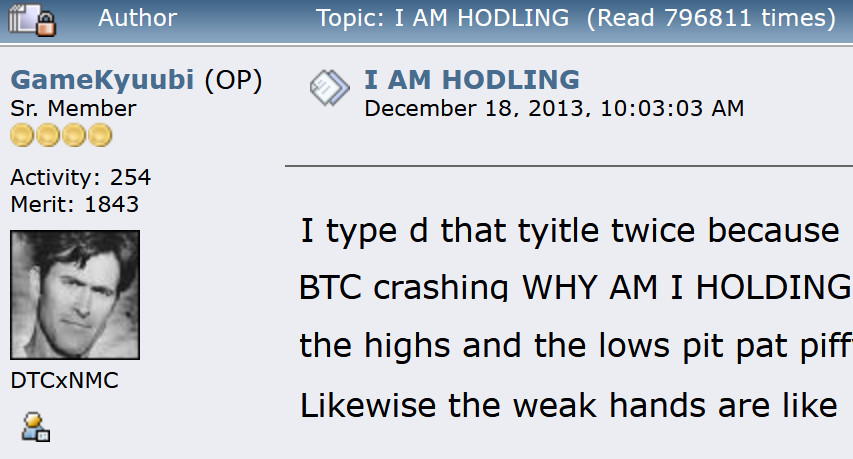
It started with a post titled “I AM HODLING.”
The user was GameKyuubi on Bitcointalk, the legendary forum that served as the heartbeat of the early Bitcoin world. The date was December 18, 2013. Bitcoin had been on a wild ride through that autumn, climbing to heights that felt surreal to people like me who had been following since the quiet days of 2011.
GameKyuubi was not a sophisticated trader. He admitted as much. He opened his post by confessing that he was a bad trader, that he had been drinking, and that he was not going to sell no matter what the market did. The word “holding” in the title came out as “hodling.”
The forums exploded with laughter. And then they adopted it.
Why HODL Resonated With Early Bitcoin Adopters
What made HODL catch on was not the typo itself. It was the emotional truth underneath it.
The early bitcoin adopters on those forums were not Wall Street traders. They were idealists, coders, libertarians, and curious outsiders. They believed in something that the rest of the world openly mocked. Every time Bitcoin crashed, the mainstream press declared it dead. Every cycle brought obituaries.
HODL was a defiant response to all of that. It was the language of people who had decided to trust their own conviction against the noise.
Within days, the community had retroactively turned the typo into a backronym: “Hold On for Dear Life.” Whether that was always the intent or not barely mattered. The community had found its motto.
HODL means something different when a hedge fund manager says it than when GameKyuubi typed it at his keyboard on a December night in 2013. The word survived the journey. The feeling behind it did not fully make it.
Angel Salvador Dominguez, Bitcoin Nostalgia
Beyond HODL: The Living Lexicon of the Original Bitcoin Community
HODL was not the beginning and it was not the end. The early forums were a laboratory for language. Words and phrases emerged organically from real conversations, real frustrations, and real moments of collective wonder.
These were not marketing slogans. They were the raw output of a subculture that had no PR team. If you want to understand what was bitcoin like in the beginning, you start with the words.
Satoshi
sat·o·shi /´sat.ə.ʃi/
The smallest divisible unit of Bitcoin: 0.00000001 BTC. Named after Satoshi Nakamoto, the pseudonymous creator. Shortened to “sat.” In the early days, the community needed a word for the smallest unit. Naturally, they named it after the creator—affectionate, practical, and a daily reminder of the mystery at the center of everything. Origin: Bitcointalk community, c. 2011
Whale
whæl
A wallet or entity holding enormous amounts of Bitcoin. Before the word migrated to mainstream finance coverage, “whale” was a Bitcointalk creation. The community watched whale addresses the way villagers once watched the weather: a whale moving coins meant something, or nothing at all. Origin: Bitcointalk community, c. 2011–2012
Rekt
rekt
Borrowed from online gaming culture, where it meant to be completely destroyed. In Bitcoin, it described the experience of selling at the absolute worst moment—only to watch prices recover within hours. Used with the dark humor of a community accustomed to extreme volatility. A significant portion of the pre-2013 bitcoin community had deep roots in IRC and gaming culture. Origin: Gaming slang, adopted by Bitcoin forums c. 2012
FUD
fʌd (acronym)
Fear, Uncertainty, and Doubt. The term predates Bitcoin by decades—it was used in tech industry marketing wars as early as the 1970s—but the community adopted it with a fervor that fit the era perfectly. Every skeptical op-ed, every government statement, every crash-driven headline: FUD. There was something both admirable and occasionally blind about that instinct. Origin: Tech industry, popularized in Bitcoin forums c. 2011
Moon
muːn
An expression for dramatic upward price movement. Before it became overused to the point of parody, “moon” captured something genuine. Saying something was “going to the moon” in 2011 was not bragging. It was the language of people watching Bitcoin climb from fractions of a cent to actual dollars. The language of space travel was the only vocabulary that felt big enough. By the 2017 cycle, the phrase had drifted into hype territory. Origin: Early Bitcoin Reddit & Bitcointalk, c. 2011
HODL
həd·l
Originally a misspelling of “holding” by Bitcointalk user GameKyuubi on December 18, 2013. Later retroactively backronymed as “Hold On for Dear Life.” A declaration of conviction against market noise. The community had found its motto in a typo made at the bottom of a crash. Read the original Bitcointalk thread in the archived record. Origin: GameKyuubi, Bitcointalk, December 18, 2013
Why This Language Matters: The Bitcoin Cultural Significance of a Private Vocabulary
Every subculture develops its own language. It is one of the ways a community defines its boundaries, marks its insiders, and preserves its values across time. The bitcoin cultural significance of this vocabulary goes well beyond humor or convenience.
These words were a form of identity. When you used them, you were signaling that you had been paying attention. That you had been in the forums when it was still a fringe idea. That you understood the emotional context behind the shorthand.
The fact that so many of these terms have now entered mainstream financial media tells you something. The culture of the early community was so cohesive, so alive, that its language outlasted its original context by more than a decade.
If you want to understand the early crypto memes and phrases, you have to understand the community that made them. A community of skeptics, dreamers, coders, and idealists who were mostly ignored until they were not.
For a deeper look at the full ecosystem of culture that these words came from, I have written extensively about it in the main archive:
Pillar Archive
The Cultural History of Crypto: Vintage Memes, Internet Lore, and the Golden Era of Bitcoin Nostalgia →That piece is the wider canvas. This article is one of its colors.

What Was Lost When Bitcoin Went Mainstream
There was a moment, somewhere around 2017, when the language shifted.
The old slang did not disappear, but it got diluted. New users arrived who had not earned the vocabulary. Phrases that had been born from genuine emotion became marketing tools. Meme accounts turned inside jokes into ad copy. The intimacy of a small, weird, idealistic community dissolved into the noise of a global financial phenomenon.
I do not say this with bitterness toward anyone who arrived later. Discovery is not a crime. But there is a real and honest grief in watching the private language of a subculture become public property without context.
HODL means something different when a hedge fund manager says it than when GameKyuubi typed it at his keyboard on a December night in 2013. The word survived the journey. The feeling behind it did not fully make it.
If you want to explore the visual and artistic side of what this culture produced, I recommend also reading:
Related Archive
Pixels, Jokes, and Rebellion: An Analysis of the Art and Memes Generated in the Early Bitcoin Community →The words and the images were always two parts of the same story.
FAQ: The Language of Early Bitcoin Culture
Where did the word HODL actually come from?
HODL originated in a Bitcointalk forum post on December 18, 2013. A user named GameKyuubi, who admitted to drinking while writing, misspelled the word “holding” as “hodling” in the title of a post where he declared he would not be selling his Bitcoin. The community embraced the typo immediately, and it was later retroactively given the backronym “Hold On for Dear Life.”
What was Bitcointalk and why was it so important to early Bitcoin culture?
Bitcointalk was an online forum created by Satoshi Nakamoto in 2009 to serve as the primary communication hub for the early Bitcoin community. It was the birthplace of many key developments, including the first recorded commercial Bitcoin transaction (the famous pizza purchase of 2010) and countless slang terms, memes, and cultural touchstones. It functioned as part technical discussion board, part community gathering space, and part historical record.
Were pre-2013 Bitcoin users really using these terms regularly?
Yes. Terms like “whale,” “FUD,” and “moon” were in active use on Bitcointalk and early Bitcoin-focused Reddit threads well before 2013. The community was small and highly interconnected, which allowed shared vocabulary to spread quickly. By the time Bitcoin started attracting wider media attention, the internal lexicon was already well established.
What does “rekt” mean in Bitcoin culture?
Rekt is slang for suffering a significant financial loss, borrowed from online gaming culture where it meant to be thoroughly defeated. In the early Bitcoin community, it described the experience of selling at a low price just before the market recovered, or more broadly, any situation where a trade went badly wrong. It was used with dark, self-aware humor by a community accustomed to extreme volatility.
Why does this language still matter today?
The language of the early Bitcoin community is a form of cultural record. It reflects the values, fears, humor, and idealism of a group of people who believed in something before the rest of the world took it seriously. Understanding where these words came from gives modern observers a more honest and complete picture of how Bitcoin became what it is. It also preserves the human stories that sit behind the price charts. The HODL entry on Wikipedia is a testament to how far this grassroots vocabulary has traveled.
Help Keep This Memory Archive Alive
These stories are not automatic. They require research, time, and a genuine commitment to preserving what the history books have mostly overlooked.
If you found this archive valuable, if reading about the night HODL was born stirred something in you, I would be grateful for your support in keeping Bitcoin Nostalgia running.
Keep This Archive Alive
Every satoshi helps this archive stay alive. If you believe these memories deserve a permanent home on the web, consider sending a small Bitcoin donation to support Bitcoin Nostalgia. Thank you for reading. Thank you for remembering.
bc1qu6v3m430v9ca0kxm3qk8cewcwukmfpf5rqakrj
Keep the memory alive.
Angel
Founder & Chief Archivist, Bitcoin Nostalgia
bitcoinnostalgia.org
Disclaimer: This article is a historical and cultural archive. Nothing in this publication constitutes financial advice, investment guidance, or price speculation. Bitcoin Nostalgia is a memory archive, not a financial publication. All historical references are based on publicly available records, archived forum posts, and documented community history. Sources include the Bitcoin whitepaper, Bitcointalk.org archives, the Bitcoin Wikipedia entry, the HODL Wikipedia entry, and the Wayback Machine.