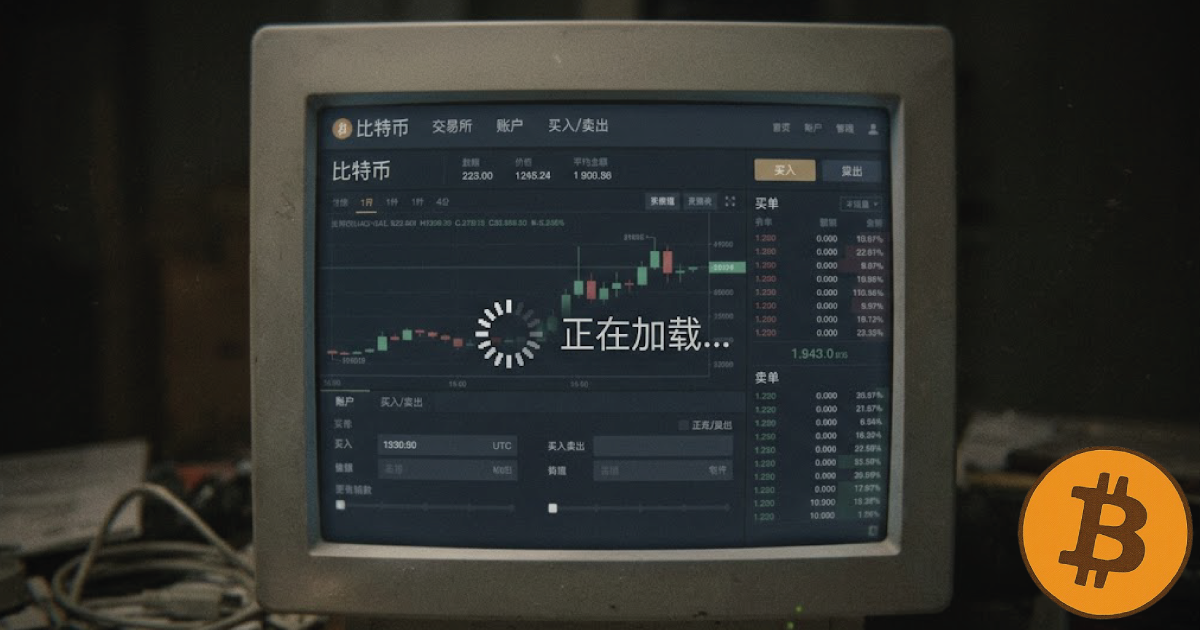
October 26, 2013. Somewhere in China, a Bitcoin investor refreshes a browser tab. The page does not load. It never will again.
The exchange was called GBL. It had appeared out of nowhere five months earlier, promising a slick Hong Kong-based trading platform. By autumn, it held the funds of thousands of Chinese investors riding the most electrifying Bitcoin wave the world had yet seen. And then, in a single evening, it was gone. The website went dark, the phone numbers disconnected, the registered address revealed to be an empty office that never existed.
This is not a story about charts or returns. This is a story about trust, about the fever of discovery, and about the human cost when opportunists exploit that fever. It is one of the earliest and most revealing chapters of bitcoin nostalgia, and it deserves to be remembered before it fades into footnotes.
The Scene: China’s Bitcoin Fever, Summer 2013
To understand why GBL could happen, you have to understand the atmosphere. In the spring and summer of 2013, something extraordinary was unfolding across China. Bitcoin, which most of the Western world still associated with fringe libertarian forums and Silk Road headlines, was becoming a genuine cultural phenomenon in mainland China.
The numbers told one story. BTC China, the country’s oldest exchange founded in 2011, was averaging 64,000 bitcoins in daily trading volume by November. It had overtaken Japan’s Mt. Gox to become the largest Bitcoin exchange on the planet. In that same month, it secured a $5 million Series A from Lightspeed China Partners, a landmark moment for the industry.
But the numbers alone did not capture the feeling. Chinese state television, CCTV, ran favorable segments about Bitcoin in late October after Canada installed its first Bitcoin ATM. Baidu, the country’s dominant search engine, began accepting Bitcoin for certain services. Internet forums buzzed with stories of graduate students turning a few hundred yuan into small fortunes overnight. As one China Daily report put it, speculators were “too crazy.”
It was a frenzy powered not just by greed, but by genuine curiosity. China had a long history with virtual currencies through online gaming. The concept of digital value was not foreign to millions of young, tech-savvy Chinese citizens. As financial analyst Zennon Kapron of Kapronasia noted at the time, online gaming, e-commerce, and mobile payments made Bitcoin “a natural fit for China, more so than many Western countries.”
Into this atmosphere of excitement and naivety, GBL arrived.
GBL: The Exchange That Was Never Really There
A Domain and a Promise
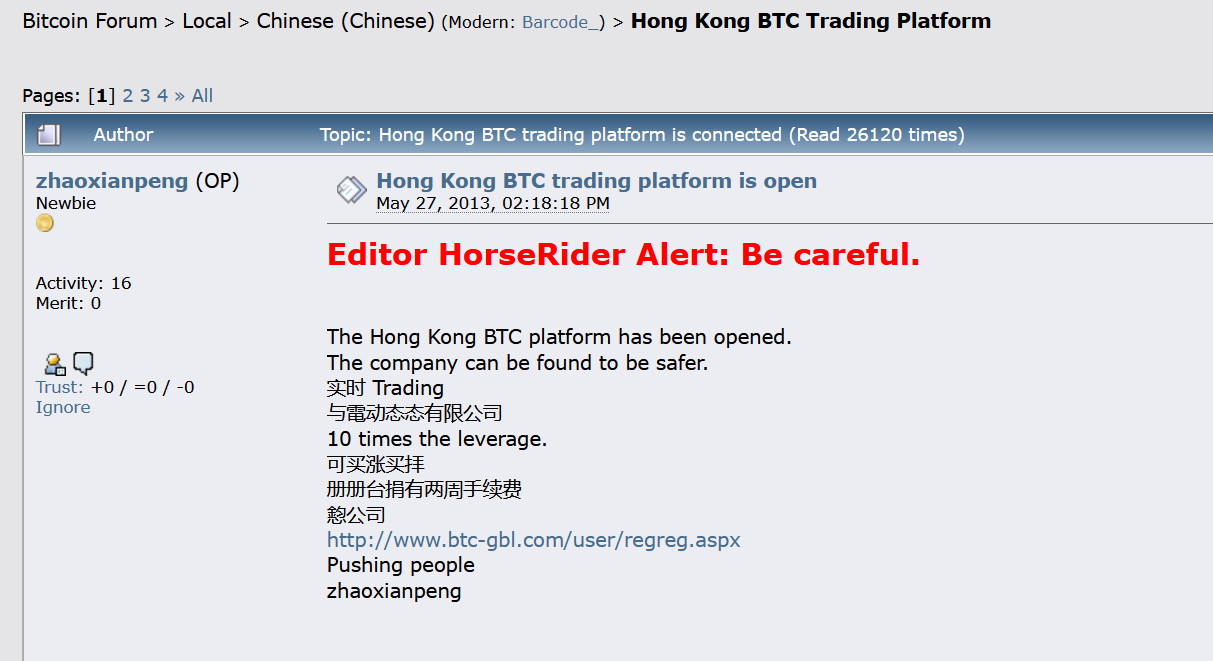
On May 9, 2013, the domain btc-glb.com was registered. Within weeks, a user named zhaoxianpeng appeared on the Bitcointalk forums promoting a new Hong Kong-based Bitcoin exchange called GBL, short for Global Bond Limited. The pitch was simple: a professional, licensed trading platform for Chinese Bitcoin enthusiasts.
Experienced Bitcointalk users were suspicious almost immediately. They noted that the site’s servers were physically located in Beijing, not Hong Kong. The forum thread eventually received a large red warning notice from a moderator: “Be careful scam.”
But warnings on English-language forums meant little to Chinese-speaking investors who would never see them. GBL’s Chinese-language interface was polished enough. The “Hong Kong” branding lent it an air of international legitimacy. And in a market this hungry, people did not stop to verify addresses.
Red Flags in Plain Sight
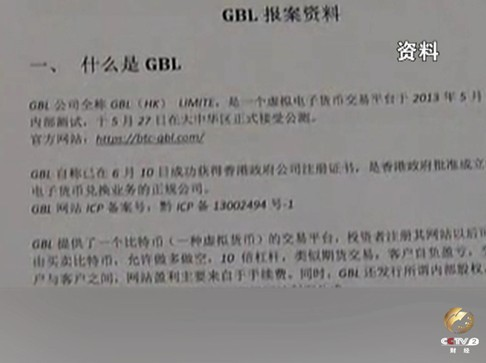
The warning signs, looking back, were textbook. GBL had registered as a company with Hong Kong authorities on June 10, 2013, but was never granted a license for financial services. The address listed on its website turned out to be entirely fabricated. The contact information was bogus. Parts of the website’s content appeared to be plagiarized from other platforms.
Yet the platform attracted approximately 4,400 registered users by the end of September. Some reports estimate that around 1,000 of them had significant funds on the platform. It grew to become what was described as China’s fourth-largest Bitcoin exchange by trading volume. All of this in under five months.
That growth was not a testament to clever deception. It was a testament to the sheer velocity of Bitcoin fever in China during the second half of 2013. People were not performing due diligence because, in a market surging this fast, due diligence felt like a luxury. Every day you waited to sign up was a day you missed the wave.
I remember watching this dynamic unfold from the forums I followed. I was not in China, and I certainly was not investing. But I recognized the energy. It was the same energy I had felt scrolling through American and European threads during the April 2013 spike. That breathless, urgent, almost religious conviction that something massive was happening. That energy is fertile ground for both innovation and exploitation.
The Disappearing Act: October 26, 2013
By September 2013, GBL began issuing what it called “stock” to its users. Around the same time, it quietly imposed caps on how much money users could withdraw. In hindsight, these were the final preparations before the exit.
On October 26, 2013, the GBL website went completely offline. Users who attempted to log in found nothing. The platform’s operators posted a final message claiming the site had been “compromised” and asked users to transfer funds to a specified bank account in order to “recover” their holdings. It was a parting insult layered on top of the initial theft.
Nostalgic Moment
I think about this sometimes. About what it must have felt like to refresh that page. To see it blank. Not a maintenance message, not a “we’ll be back soon” screen. Just nothing. An entire platform, and everything you had trusted it with, simply erased from the internet.
In the early days of Bitcoin, there were no safety nets. No insurance funds, no regulatory bodies to call, no customer support hotlines. There was just you, a browser, and the sinking realization that the future you had bet on had vanished into the same digital ether it came from.
The estimated losses were staggering for the era. Reports converged on approximately $4.1 million worth of Bitcoin, roughly 25 million Chinese yuan. According to records referenced in the Bitcointalk community’s historical tracking thread, the amount stolen was estimated at around 22,000 BTC at contemporary market rates. Given that Bitcoin’s price would spike to over $1,200 just weeks later during the November bubble, the true value of the theft expanded dramatically in the weeks after the exit.
The Aftermath: Searching for Ghosts
The Victims Organize
News of the scam took time to surface in English-language media. It was a Bitcoin investor using the pseudonym “South American Vicuna,” who also ran a smaller Chinese exchange called btcmini.net, who brought the story to wider attention. Vicuna told the Chinese publication IT Times about the scale of the losses and began organizing an online group of victims to gather evidence.
The victims faced an almost absurd obstacle: the authorities had no idea what Bitcoin was. Investors in Shanghai who approached local police were turned away. According to reports from IT Times, officers reportedly asked what Bitcoin even was and how many coins one could buy with a single yuan. In 2013, Bitcoin occupied a regulatory grey zone in China. It was neither officially recognized nor explicitly banned, and local police had no framework, no precedent, and frankly no vocabulary to investigate its theft.
This detail is worth sitting with. It captures something essential about the early days of Bitcoin. The technology had raced ahead of every institution meant to protect the people using it. Exchanges operated without oversight. Losses had no recourse. The entire ecosystem ran on trust, and when that trust was violated, victims found themselves standing alone.
The Arrests
Justice, remarkably, did come. In early December 2013, Chinese authorities announced the detention of three suspects connected to GBL. According to a report from the Xinhua News Agency, the mastermind had created the exchange back in May. A 24-year-old man had managed the platform’s daily operations, and a 33-year-old had handled its finances. They were apprehended just weeks after the shutdown.
The arrests represented one of the earliest known instances of law enforcement action related to cryptocurrency fraud anywhere in the world. But for many victims, it was cold comfort. The Bitcoin had already been moved and dispersed. The money was gone.
GBL in the Larger Story: Why This Scam Still Matters
GBL was not the largest early Bitcoin theft. That distinction would soon belong to Mt. Gox, whose collapse in early 2014 would shake the entire movement to its core. GBL was not the most culturally infamous. The Silk Road shutdown, which happened just three weeks before GBL vanished, had already dominated global headlines.
But GBL occupies a unique and instructive place in the history of bitcoin nostalgia for several reasons.
First, it was a pure exit scam. Unlike Mt. Gox, which was a legitimate exchange destroyed by a combination of hacking and mismanagement, GBL appears to have been fraudulent from its very first day. The fake address, the unregistered license, the plagiarized website content. It was designed to steal from the beginning. This makes it one of the earliest documented examples of a deliberate crypto exit scam, a blueprint that would be replicated hundreds of times in the years to come during the ICO craze of 2017 and beyond.
Second, it revealed the specific vulnerability of the Chinese market. China’s relationship with Bitcoin was driven by a unique combination of cultural factors: a tradition of high savings rates, limited domestic investment options, massive enthusiasm for digital innovation, and a population already comfortable with virtual currencies through online gaming. GBL exploited all of these factors simultaneously.
Third, and most critically, GBL happened at the very moment China was ascending to become the dominant force in global Bitcoin trading. The exchange disappeared on October 26. Less than a month later, BTC China would reach record volumes, Bitcoin would cross $1,000 for the first time, and Chinese demand would be credited as the leading catalyst for the November 2013 bubble. GBL was the shadow side of that historic surge.
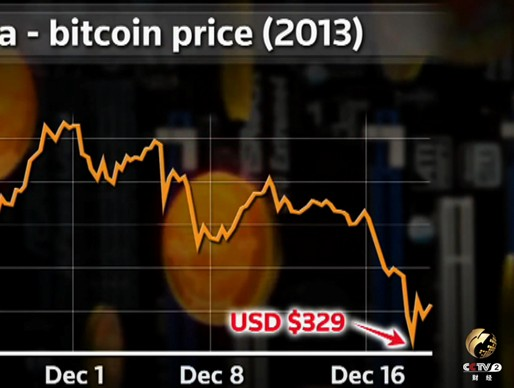
The Bitcoin community tracked these events meticulously. A comprehensive list of early Bitcoin thefts and scams, maintained by users on Bitcointalk, catalogued more than 30 separate incidents between 2011 and late 2013 alone. Reading through that list today is a strange, sobering exercise in bitcoin nostalgia. Each entry represents not just lost coins, but lost trust, and sometimes lost years of work.
Those early losses also trace a direct line to the security infrastructure we see today. Multi-signature wallets, proof-of-reserves audits, cold storage protocols, regulatory licensing frameworks. All of these exist, in part, because of what happened at places like GBL. Every security feature in the modern crypto ecosystem is a scar left by an earlier wound. The story of the first Bitcoin transaction between Satoshi and Hal Finney was one of trust. The story of GBL was trust betrayed. And somewhere between those two poles, the Bitcoin ecosystem learned to build systems that would require less trust and more verification.
What GBL Taught the Early Bitcoin Community
Looking back from 2013 to today, it can be tempting to view early scams like GBL as quaint relics. The dollar amounts seem modest compared to more recent collapses. But scale is not the point. The emotional and cultural impact was enormous for the people involved.
For many of GBL’s victims, this was their first exposure to Bitcoin. They were not cypherpunks or hackers. They were everyday people, savers, students, small investors who had heard about a new kind of money on the evening news. Their losses were not abstractions. Those were real savings, family money, in some cases funds that people could not afford to lose.
The GBL scam also arrived at a pivotal moment for Bitcoin’s broader cultural journey from underground experiment to global phenomenon. Every time Bitcoin reached a new audience, scammers were already there, waiting. The community learned, slowly and painfully, that decentralization was both Bitcoin’s greatest strength and its greatest vulnerability. Without gatekeepers, anyone could build a platform. Without regulators, no one could guarantee it was real.
That tension, between the open promise of trustless money and the very human need for someone to trust, is a thread that runs through every chapter of Bitcoin’s history. It runs through the Pizza Day transaction in 2010, through the blocksize wars, and through the GBL scam of 2013. It has never been resolved. It probably never will be.
Frequently Asked Questions
What was GBL in Bitcoin history?
GBL, or Global Bond Limited, was a Chinese Bitcoin exchange that operated from May to October 2013. It claimed to be based in Hong Kong, but investigations revealed that its address was fabricated, its servers were in Beijing, and it never received a financial services license. It is considered one of the first deliberate cryptocurrency exit scams.
How much Bitcoin was lost in the GBL scam?
Estimates vary by source. The most widely cited figure is approximately $4.1 million in value at the time of the theft (around 25 million Chinese yuan). Some community records on Bitcointalk estimate the total at approximately 22,000 BTC. Because Bitcoin’s price surged to over $1,200 in November 2013, the value of the stolen coins expanded significantly just weeks after the scam.
Were the people behind GBL ever caught?
Yes. In early December 2013, Chinese authorities detained three suspects connected to the GBL operation. According to Xinhua News Agency, the group included the mastermind who created the exchange, a 24-year-old who managed daily operations, and a 33-year-old who handled finances. The arrests were among the earliest known law enforcement actions targeting cryptocurrency fraud worldwide.
Why did so many Chinese investors trust GBL?
The timing was critical. GBL launched during a period of explosive Bitcoin enthusiasm in China, fueled by favorable CCTV coverage, Baidu’s acceptance of Bitcoin payments, and surging prices on BTC China, the nation’s largest exchange. Many of GBL’s users were newcomers to Bitcoin with little experience evaluating exchanges, and the market’s rapid growth discouraged due diligence.
How does the GBL scam connect to the November 2013 Bitcoin bubble?
GBL’s shutdown on October 26, 2013 occurred just weeks before Bitcoin’s price surpassed $1,000 for the first time, a surge widely attributed to Chinese demand. The scam and the bubble were products of the same underlying phenomenon: an unprecedented wave of Chinese enthusiasm for Bitcoin that attracted both genuine participants and opportunistic fraudsters.
Help Keep This Archive Alive
Stories like these do not preserve themselves. If you lived through Bitcoin’s early days, or if you simply believe that the human side of this revolution deserves a place in the record, help keep this archive alive. Every contribution, no matter how small, ensures that the lessons of GBL, and the people it affected, are never reduced to a forgotten footnote.
Keep This Archive Alive
Every satoshi contributed is a vote for memory over forgetting. Bitcoin Nostalgia runs on community support. Thank you for reading. Thank you for remembering.
bc1qu6v3m430v9ca0kxm3qk8cewcwukmfpf5rqakrj
Keep the memory alive.
Angel
Founder & Chief Archivist, Bitcoin Nostalgia
bitcoinnostalgia.org
Disclaimer: This article is a historical and cultural archive. Nothing in this publication constitutes financial advice, investment guidance, or price speculation. Bitcoin Nostalgia is a memory archive, not a financial publication. All historical references are based on publicly available records, archived forum posts, and documented community history. Sources include CoinDesk, Bitcointalk.org archives, the Bitcoin Wikipedia entry, The Register, and Xinhua News Agency reporting.