Somewhere in the archives of a dying server, there are plain-text emails that changed the world. Most people will never read them. Most people have no idea they exist.
But before there was a whitepaper, before there was a genesis block, before there was a price to check on your phone at midnight, there was a mailing list. A quiet, unglamorous thread of digital conversation where a few hundred strangers spent years arguing about a question nobody else was asking: what would money look like if the government could not touch it?
Here is the problem with bitcoin nostalgia the way most people practice it. It starts in 2013, maybe 2011 if they are feeling adventurous. It starts with price charts and forum posts about cheap coins. It rarely goes back far enough to find the soil in which Bitcoin actually grew.
The real origin story does not start with Satoshi. It starts with a group of mathematicians, hackers, and libertarian dreamers who met in a living room in Oakland, California in 1992. If you want to understand where Bitcoin came from, you have to start there.
I did not live this chapter. I came to Bitcoin around 2010, a quiet observer watching forums light up with excitement I barely understood. But I have spent years going back, digging through the archives, reading the old threads before the links rotted. This is what I found.
Oakland, 1992: The Night the Movement Got Its Name
In late 1992, about twenty people gathered in a house in Oakland, California. They were programmers, mathematicians, and committed privacy advocates who had been circling each other at conferences for years. That evening, three of them had decided it was time to stop meeting at conferences and start meeting regularly.
The Three Who Started It
Their names were Eric Hughes, a brilliant Berkeley mathematician who had recently spent time in the Netherlands working with cryptographer David Chaum. Timothy C. May, a retired Intel engineer who had made enough from his early stock options to dedicate his life to radical ideas about cryptography and freedom. And John Gilmore, the fifth employee at Sun Microsystems, co-founder of the Electronic Frontier Foundation, and a man who genuinely believed that the open internet could be a force for human liberation.
These were not academics writing papers for tenure committees. They were builders who believed, with genuine urgency, that the coming digital age would be either a tool of surveillance or a tool of freedom, and that the difference depended entirely on whether ordinary people had access to strong cryptography.
At that first meeting, Tim May stood up and read aloud a short document he had been circulating at hacker conferences since 1988. He called it the Crypto Anarchist Manifesto.
The Crypto Anarchist Manifesto was blunt and visionary in equal measure. It imagined a world where cryptographic technology would allow individuals to exchange information and transact business entirely anonymously, without governments or corporations knowing who was involved. “Just as the technology of printing altered and reduced the power of medieval guilds and the social power structure,” May wrote, “so too will cryptologic methods fundamentally alter the nature of corporations and of government interference in economic transactions.”
The room was quiet for a moment after he finished. Then the arguments started, and they did not really stop for the next sixteen years.
A Name Born From a Joke
That first meeting also produced the name. One of the attendees was Jude Milhon, a programmer and writer who published under the alias St. Jude and contributed to the magazine Mondo 2000. She looked at the group, thought about what they were doing, and made a pun. They were doing cryptography, cipher work. They had the rebellious spirit of the cyberpunk fiction that writers like William Gibson were making famous. So she called them the cypherpunks. It was, May would later say with a laugh, a bit of a marketing ploy. The name stuck anyway.
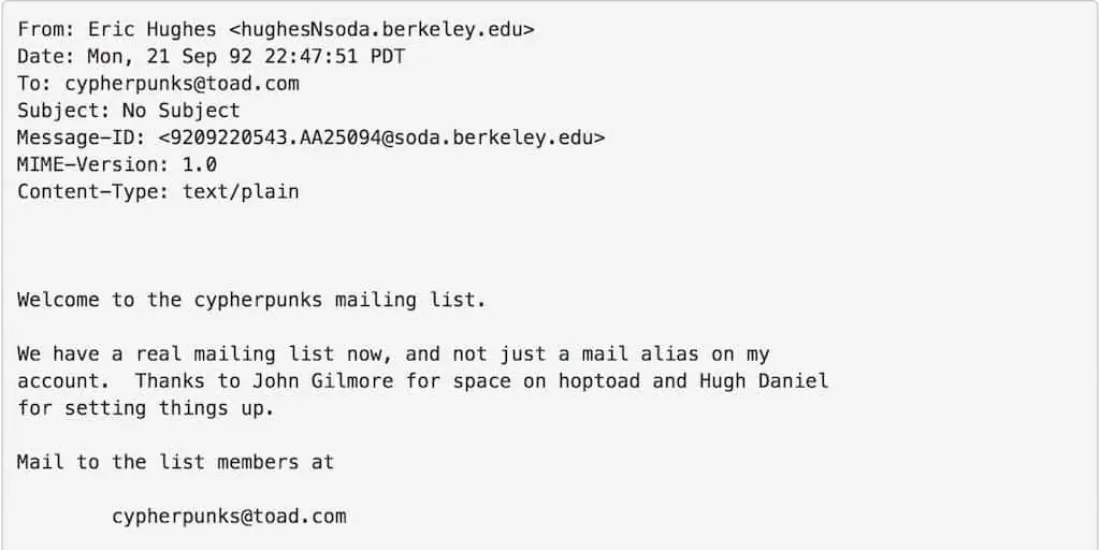
Eric Hughes set up a mailing list almost immediately after. It lived on a server belonging to Gilmore, a machine simply known as toad.com. Subscriptions required nothing but an email address. There were no moderators, no rules about tone, and no agenda beyond the conversation itself.
Life on toad.com: What the List Actually Looked Like
By 1994, roughly 700 people had subscribed. By 1997, estimates put the list at close to 2,000 active members. These numbers sound modest today. In the mid-1990s, they represented a genuinely significant concentration of technical talent and political philosophy in a single digital space.
The Conversations That Never Made the News
The list discussed everything. Cryptographic protocols, yes, but also philosophy, law, civil liberties, and the raw mechanics of how surveillance states operated. It was noisy and sometimes chaotic. There were lengthy arguments about whether strong encryption was moral, whether anonymity could be abused, whether the whole project was naive utopianism.
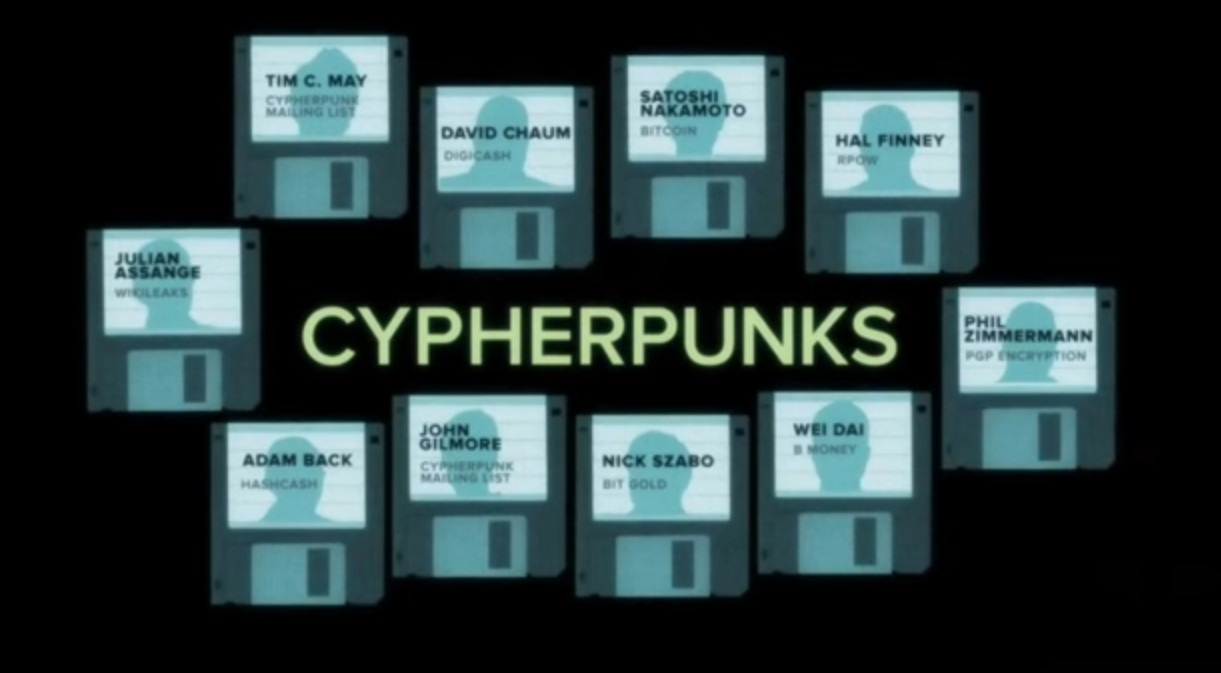
Notable figures drifted through or stayed. Julian Assange, who would later found WikiLeaks, participated in the early discussions. Phil Zimmermann, who wrote PGP and was investigated by the US government for distributing it, was part of the orbit. The list was a strange mix of genius and idealism, with occasional bursts of paranoia that, in retrospect, turned out to be completely justified.
The US government was, at that exact moment, trying to force a backdoor into all encryption with something called the Clipper chip. The NSA was lobbying Congress to classify strong encryption as a weapon and ban its export. The cypherpunks were not imagining threats. The threats were real, visible, and moving through Washington while they typed.
Cypherpunks Write Code
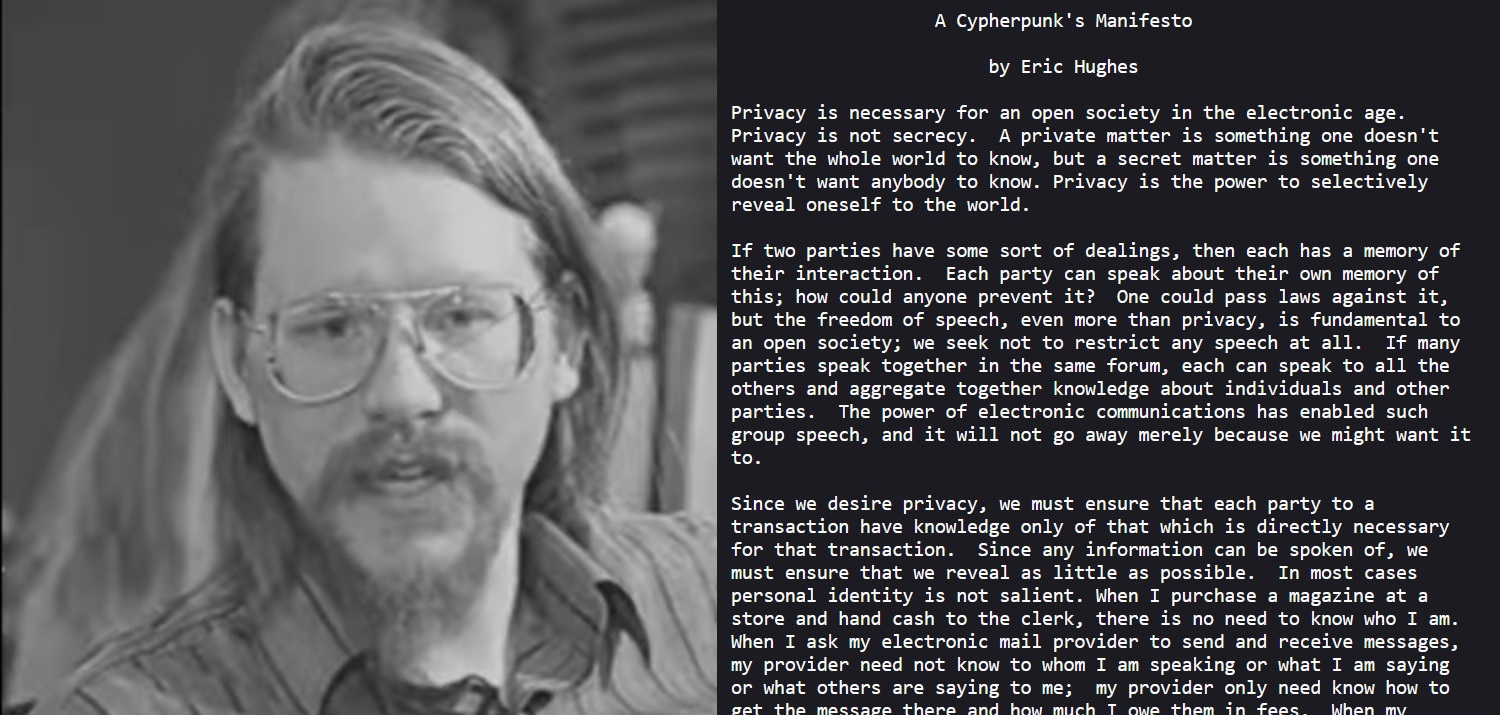
In 1993, Eric Hughes wrote A Cypherpunk’s Manifesto. Its most famous line was also its most operational: “Privacy is not secrecy. A private matter is something one doesn’t want the whole world to know, but a secret matter is something one doesn’t want anybody to know. Privacy is the power to selectively reveal oneself to the world.”
The manifesto then drew a line in the sand. Cypherpunks, Hughes wrote, do not ask governments for privacy. They take it, by writing and deploying cryptographic code. The motto that emerged from this was four words that would define the group’s entire approach: cypherpunks write code.
This was not a theoretical distinction. The list was a place where people built things. Anonymous remailers, privacy tools, early experiments in digital signatures. The code came first. The philosophy was what you wrote when you needed to explain the code to someone who did not already understand why it mattered.
The Dream of Money That Nobody Could Freeze
Among all the things the cypherpunks debated, one topic kept returning, year after year, in different forms and with different names. They wanted money that worked like cash online. Anonymous, peer-to-peer, impossible to censor. The seed of the wild west ethos early Bitcoin would later embody was being planted right here, in these quiet email threads.
David Chaum and the First Glimpse
The concept was not new even in 1992. David Chaum, a cryptographer at the University of California Berkeley and later the CWI in Amsterdam, had already imagined private electronic cash in the early 1980s. His company, DigiCash, launched a product called ecash that allowed payments to be made without revealing the spender’s identity to the merchant or the bank.
Eric Hughes had actually worked with Chaum in Amsterdam before helping found the cypherpunks. The dream of anonymous digital money was part of the group’s DNA from the very first meeting.
The problem with DigiCash was structural. It was privacy-preserving, but it still required a central issuer. The company controlled the supply. If DigiCash failed, the money failed. And DigiCash did fail: it filed for bankruptcy in 1998. The cypherpunks had watched it rise and collapse, and they had learned something important. Central points of control were also central points of failure.
Three Builders Who Got Agonizingly Close
After DigiCash, the attempts grew more radical and more technically sophisticated. Three names stand above the others.
In 1997, Adam Back invented Hashcash, a system designed originally to combat email spam. To send an email, your computer had to do a small, verifiable amount of computational work first. That proof of work could be checked instantly by the recipient but was genuinely costly to produce. This was the first working implementation of the concept that would later secure the Bitcoin network.
In 1998, Wei Dai published a proposal he called b-money. It described a system for anonymous, distributed electronic cash where participants would maintain ledgers and transactions would be enforced by cryptographic proof rather than institutional trust. Dai was the first to sketch something close to the full shape of what Bitcoin would become. Satoshi Nakamoto would later cite b-money directly in the Bitcoin whitepaper.
Around the same years, Nick Szabo was developing an idea he called bit gold. Bit gold also used proof of work to create tokens of value, and Szabo explicitly wanted to remove the need for a trusted third party from the transaction entirely. The resemblance to Bitcoin is close enough that Szabo remains one of the most frequently named candidates for Satoshi Nakamoto’s identity, a connection he has consistently denied.
The Problem None of Them Could Fully Crack
Each of these systems solved a piece of the puzzle. Hashcash gave you proof of work. B-money gave you a vision of a distributed ledger. Bit gold gave you scarce, verifiable tokens. But none of them solved the double-spend problem in a way that worked without any trusted party at all.
If you could spend the same digital token twice, the currency was worthless. And without some central authority keeping the ledger, how could the network agree on which transaction came first? This was the question that the cypherpunks kept bumping against through the late 1990s and the early 2000s. The answer was theoretically possible, they believed. Nobody had found it yet.
The Long Silence: How the List Faded Before the Answer Arrived
This part of the story is the one that breaks my heart a little, every time I revisit it.
From toad.com to the Distributed Era
By the late 1990s, the original cypherpunks list on toad.com had grown unwieldy. In 1997, the list migrated to a distributed architecture, running on multiple independent nodes using Majordomo software. At its peak, there were seven nodes. The idea was resilience, a nod to the anti-censorship philosophy of the group itself.
But distributed is not the same as permanent. Nodes dropped off one by one through the early 2000s. By mid-2005, only a single node remained, hosted on a domain whose name was itself a cypherpunk joke at the government’s expense.
The energy was fading. Some members had moved on to other projects. Some had concluded that the problem of trustless digital money was unsolvable without some central point of authority. The Crypto Wars of the 1990s had largely been won: PGP survived, the Clipper chip failed, strong encryption became legal to export. But the original dream of money without masters was still unfinished business.
What Remained When the Room Went Quiet
The work did not disappear. It migrated. Smaller, more technical mailing lists continued the conversation. The bitcoin-dev mailing list. The cryptography list at metzdowd.com. Researchers like Nick Szabo and Wei Dai stayed in contact. Hal Finney, who would become the first person to receive a Bitcoin transaction, remained active and deeply committed to the idea that digital cash could be made to work.
The original cypherpunks list had planted something. By the time it went quiet, the seed had already scattered into the soil of the broader cryptography community. It was waiting, as seeds do, for the right conditions.
From the Archive — Iconic Events & Milestones
The First Bitcoin Transaction: The Day Satoshi Sent 10 BTC to Hal Finney and Changed EverythingThe cypherpunk mailing list planted the idea. Hal Finney was the first one to catch it in practice. This is the story of Block 170 and the morning of January 12, 2009.
Halloween 2008: The Question Finally Had an Answer
Here is the part I always sit with for a moment before I write it.
By October 2008, the original cypherpunks list was effectively dead. The conversation had settled into a quieter successor, the Cryptography Mailing List hosted at metzdowd.com, run by and subscribed to by many of the same people who had shaped the cypherpunks for fifteen years. It was a smaller, more technical list. Less chaotic, less famous, but still the closest thing to a living thread connecting back to 1992.
Nostalgic Moment
Picture Tuesday, October 28, 2008. The world is in free fall.
The United States Congress had just passed a 700 billion dollar bailout for the banks. Stock markets were melting down. Iceland’s entire banking system had effectively collapsed. Governments everywhere were printing emergency money to save institutions that had spent decades treating risk like a renewable resource.
And somewhere, on a quiet corner of the internet that still remembered why cryptography mattered, a message was being composed.
On October 31, 2008, at approximately 2:10 in the afternoon Eastern time, a message appeared on the Cryptography Mailing List at metzdowd.com. The subject line was: ‘Bitcoin P2P e-cash paper.’ The sender called themselves Satoshi Nakamoto. The message said, simply: ‘I’ve been working on a new electronic cash system that’s fully peer-to-peer, with no trusted third party.’
There was a link to a nine-page PDF. Sixteen years of arguments had just received their answer, delivered like a quiet note slipped under a door.
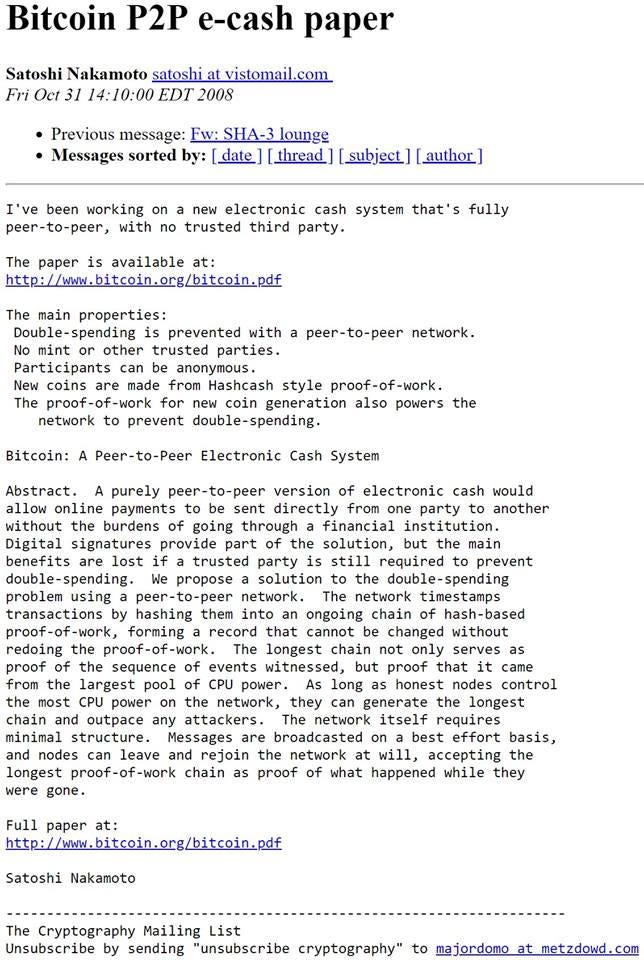
Primary Source
Read the original whitepaper announcement on the Cryptography Mailing List:
metzdowd.com — “Bitcoin P2P e-cash paper” — Satoshi Nakamoto, October 31, 2008
The Bitcoin whitepaper itself remains hosted at:
The First Replies: Doubt Before Faith
The response was not thunderous. A small handful of people replied over the next few days. One of the earliest was James Donald, a long-time list participant, who told Satoshi the system would not scale. Ray Dillinger raised concerns about the energy cost. Most subscribers did not reply at all. Satoshi Nakamoto patiently answered every technical objection, then posted again on November 3 to make sure people had seen the paper.
The exception was Hal Finney. Finney was a veteran of the cypherpunks era, a developer who had built some of the first PGP tools and who had spent years genuinely believing that digital cash was a solvable problem. He read the paper, and he understood immediately what it was. He downloaded the software. On January 12, 2009, he received 10 BTC from Satoshi Nakamoto in the first Bitcoin transaction ever made. Then he went back to his desk and kept working.
No press release. No announcement. Just two people, one problem solved, and the quiet beginning of something the world would take years to notice.
What the Cypherpunks Left Behind
It is easy to look at Bitcoin today and see it as something that arrived fully formed from a single brilliant mind. The history suggests something different. Bitcoin arrived at the end of a sixteen-year conversation that most of the world was not having.
The DNA You Can Still Read in the Protocol
Open the Bitcoin whitepaper and read the references section. Adam Back’s Hashcash is cited. Wei Dai’s b-money is cited. The proof-of-work system that secures the Bitcoin network is a direct descendant of the same concept Back used to fight email spam in 1997.
The philosophy is embedded even more deeply. The insistence on no trusted third party. The design goal of permissionless participation. The use of cryptographic proof rather than institutional trust to verify transactions. Every one of these principles was debated and refined on the cypherpunks list across hundreds of threads that most people will never read.
Bitcoin did not invent the dream of trustless digital money. It solved the last technical problem that had been blocking it. That is a meaningful distinction, and it is one the origin story loses when we let it begin too late.
The Archives Are Fading and We Are Running Out of Time
The cypherpunks legacy archives still exist, hosted at lists.cpunks.org. The Wayback Machine has crawled some of the threads. But digital preservation is fragile work. Links rot. Servers go offline. The people who remember the context behind the arguments are getting older.
This is what bitcoin nostalgia is really about, at its core. Not the prices of 2011. Not the giddy forum posts about cheap coins. It is about preserving the record of a conversation that shaped one of the most significant technological events of the early twenty-first century—a conversation that took place in plain text on a mailing list that most of the people who own Bitcoin today have never heard of.
If we do not keep this memory alive, it will become a footnote. And the footnote will eventually disappear.
Pillar — Early Days & Genesis
The Genesis Era: A Comprehensive Guide to Bitcoin’s Early Days and Technological OriginsThe cypherpunk mailing list is one chapter in a much longer story. This pillar guide covers the full arc of Bitcoin’s genesis era—from the first cryptographic experiments through the launch of the network in January 2009.
From the Archive — Early Days & Genesis
What Defines the ‘Good Old Days’ of Bitcoin? A Look Back at the Era That Started It AllIf the cypherpunk era is the prehistory, what was the early Bitcoin community actually like once the network was running? This archive piece traces the culture, the characters, and the feeling of those foundational years.
From the Archive — Early Days & Genesis
Satoshi’s Vision: What Was Bitcoin Really Like in the Beginning?The whitepaper was the answer. But what did Satoshi actually intend—and how closely did the early network match that vision? A close read of the original documents and forum posts.
Help Keep This Memory Archive Alive
Stories like this one do not write themselves. Preserving the culture, the philosophy, and the forgotten voices of early Bitcoin takes time, research, and a genuine commitment to getting the details right.
If the cypherpunk origins of Bitcoin matter to you, if you believe the human story behind the protocol is worth keeping alive, consider supporting Bitcoin Nostalgia. Every contribution helps restore forgotten threads, track down broken links, and keep building this archive for whoever comes to this story next.
Keep This Archive Alive
Every satoshi contributed is a vote for memory over forgetting. Bitcoin Nostalgia runs on community support. Thank you for reading. Thank you for remembering.
bc1qu6v3m430v9ca0kxm3qk8cewcwukmfpf5rqakrj
Every sat counts. Every story matters.
Keep the memory alive.
Angel Salvador Dominguez
Founder & Chief Archivist, Bitcoin Nostalgia
bitcoinnostalgia.org
Disclaimer: This article is a historical and cultural archive. Nothing in this publication constitutes financial advice, investment guidance, or price speculation. Bitcoin Nostalgia is a memory archive, not a financial publication. All historical references are based on publicly available records, archived forum posts, and documented community history. Sources include Wikipedia — Cypherpunk, A Cypherpunk’s Manifesto (activism.net), The Crypto Anarchist Manifesto (activism.net), Satoshi’s original whitepaper announcement (metzdowd.com), and the cypherpunks legacy archives.